Non-Competition & Injunctions
When you buy a business, it is common for the seller to agree to non-competition restrictions. In other words, the seller agrees not to compete against you for a certain period of time afterwards. These clauses are standard, but can be tricky to enforce, as shown in the recent decision in Belron Canada Incorporated v. TCG International Inc., 2009 BCSC 596 (CanLII).Â
In 2005, Belron bought the Speedy Auto Glass business in Canada from TCG for about $53 million, a deal which included the trade-marks, franchise agreements and proprietary glass repair technology. For this price, Belron expected that TCG would refrain from competing against Belron in the auto-glass repair business in Canada for seven years.
When TCG launched a website at www.windshields.com that seemed to target Canadian customers, Belron sued for breach of the non-competition promises, and sought an injunction to restrain TCG from operating the site in Canada. In this case, the court wasn’t convinced that the injunction should be issued, so the case will go to trial for a final decision on whether the site constitutes a breach of the non-competition obligations. The Belron decision applied the recent Supreme Court of Canada decision in Shafron v. KRG Insurance Brokers (Western) Inc., 2009 SCC 6, a case which debated the meaning of the phrase “Metropolitan City of Vancouver†in a non-competition clause. The Shafron decision also illustrates the importance of taking care in drafting clear non-competition clases.
The lessons for business?
- In any business acquisition, it is important for both sides to get advice on non-competition, non-solicitation and non-interference clauses to ensure the clauses are clear and enforceable;
- Where intellectual property assets are involved (as in the Belron case), special care must be taken to also review post-closing confidentiality and trade-secret obligations;
- “Injunctive Relief” clauses, which state that one party is automatically entitled to an injunction, are not necessarily enforceable. Belron had such a clause in its contract with TCG, but the court still did not issue the injunction order.
Calgary – 09:00 MSTÂ Â
No commentsThe Risks of Rebranding


Rebranding is supposed to provoke a response, right? Consumer interest? Marketing awards? A trade-mark lawsuit?
Brick Brewing Co., an independent Ontario brewery, recently rebranded their Red Baron beer, updating the look with a new label, to the right. The old label, at left, was used since the late 1980s and was registered as a trade-mark in 1991.

The new label attracted the attention of rival Labatt Brewing Company and last week Labatt sued for trade-mark infringement and sought an injunction, alleging that the new Reb Baron label was confusing with Labatt’s Brava label (left). The Brava label was also registered as a trade-mark in April, 2009.
Though the word marks RED BARON v. BRAVA, for beer, are not at all similar, the look, colour, and layout of the labels is arguably more similar, since the word Baron is given more prominence in Brick’s new label. This highlights the risks of rebranding. The lessons for business? Sometimes an updated label will be launched without the same level of scrutiny that is given to a new brand. Even with a “soft” launch such as this, trade-mark searches, trade-mark advice and industry awareness can help mitigate the risk of trade-mark disputes before a new brand or label is launched.
And sometimes, you get hit with a lawsuit just because your competitor is your competitor.
Calgary – 10:30 MST
No commentsipblog.ca on your BlackBerry or iPhone
ipblog.ca is available on your web browser from your BlackBerry or iPhone. Bookmark the site for updates, articles and business tips on Canadian intellectual property law, trade-marks and internet law in the palm of your hand.Â
Calgary – 10:00 MST
No commentsBarbie Clobbers Bratz: Intellectual Property Decision
 In the long-running IP battle between Mattel Inc., the makers of Barbie dolls, and MGA Entertainment Inc., the makers of rival Bratz dolls, a California federal court has issued a decision this week that appears to put a nail in the Bratz coffin. The court dismissed MGA’s application to reduce the $100 million damage award granted to Mattel Inc. and went further. The court also implemented the order which bars MGA from making or selling the Bratz dolls. A temporary receiver was also appointed to oversee MGA’s business. The end of the battle appears to be near, through Bratz may still have some fight left. The dispute arose after a designer, while he was under contract with Mattel, designed the Bratz concept, then secretly sold the concept to MGA.  The dispute centred on copyright and intellectual property claims that ultimately put the Bratz designs back into the possession of Mattel.
The lessons for business? MGA obviously knew what it was doing, but to avoid the risk of inadvertently importing intellectual property belonging to a competitor, consider special clauses in employment and contractor agreements that can help mitigate the risks of hiring employees or contractors who bring trade secrets or IP with them when they join your company.
Calgary – 11:45 MST
No commentsCanadian Copyright Class Action
A Quebec Superior Court judge has approved a class action in the case of Electronic-Rights Defence Committee ERDC c. Southam Inc. 2009 QCCS 1473 (search for ERDC in Superior Court judgements), a copyright case dealing with the inclusion of freelance articles in online databases, which could prove to be as important as the 2006 Supreme Court of Canada decision in Robertson v. Thomson Corp., 2006 SCC 43 [See: New Copyright Decision Released], the copyright battle pitting freelance writer Heather Robertson against the publishers of the Globe and Mail.
The impact on business? Just because you think you own the copyright in a particular work, don’t assume that right includes the right to reproduce the work in any and all media. We have been advising clients to include contractual language to clarify the rights of reproduction to include digital media.
Calgary – 18:20 MST
No commentsProposed Canadian Anti-Spam Law
On Friday, the federal government introduced long-overdue draft anti-spam legislation, the Electronic Commerce Protection Act. The law would allow civil lawsuits against spammers, and is designed to target email spam, as well as spam directed to cellphones and mobile devices. The proposed law would be enforced by the Privacy Commissioner, the Competition Bureau, and the CRTC, which raises questions about effective coordination of enforcement across multiple branches of government and quasi-government bodies. The law contemplates fines of up to $1 million for individuals and $10 million for corporate offenders.
Calgary – 20:45 MST
No commentsCanadian Company Wins Round in Patent Battle
A year ago we posted a Patent Infringement Update on this case; earlier this month the USPTO rejected all 57 claims in a course-management software patent that US-based Blackboard Inc. used to successfully sue its Canadian competitor, Desire2Learn. The most recent rejection relates to claims added during the re-examination process [copies of the documents are posted here]. Blackboard originally obtained the software patent in 2006, but the patent was criticized for its broad claims covering technology that had been used by educational institutions and others for years at the time of filing. The battle is likely to continue, as Blackboard has since filed a new patent, and is suing its rival again for infringement of the new patent.
Calgary – 11:00 MST
No commentsIP Licenses and Bankruptcy
What happens when a licensor becomes insolvent?
When Body Blue Inc., a Canadian consumer products company, stumbled financially, a receiver was appointed in Canada under the Bankruptcy and Insolvency Act. In its attempt to restructure the company and satisfy creditors, the receiver sold the company’s assets in May, 2006 for $7 million to a competitor consumer products company. The assets expressly included certain technology which was the subject of an earlier license to Herbal Care, a US health products company.Â
Herbal Care argued that its license remained unaffected. However, a Canadian Court can allow a trustee to transfer the technology assets of a bankrupt company free and clear of any existing license.
In the final decision in Royal Bank of Canada v. Body Blue Inc., 2008 CanLII 19227 (ON S.C.), the Canadian Court affirmed that the new owner acquired the transferred assets free and clear of any claim of Herbal Care. Herbal Care lost its license when the assets were transferred during the bankruptcy.
This result can be contrasted with Synergism Arithmetically Compounded Inc. v. Parkwood Hills Foodland Inc., 2000 CanLII 22781 (ON S.C.), where certain intellectual property assets – in this case, an insolvent company’s trade-marks and franchise agreements – were the subject of a security agreement. A secured creditor stepped in, enforced its security, and acquired all the insolvent company’s trade-marks and franchise agreements. Because the trade-marks were acquired by the secured creditor outside the bankruptcy, they never passed through the hands of the trustee, and they were transferred with the license rights intact. Thus the new owner was entitled to sue for breach of the license, and trade-mark infringement, since it had acquired those rights along with the trade-mark assets.
As always, careful drafting and preventive steps can mitigate these risks.
Links to the case decisions:
Royal Bank of Canada v. Body Blue Inc.
Synergism Arithmetically Compounded Inc. v. Parkwood Hills Foodland Inc.
Calgary – 10:00 MST
Departing Employees & Trade Secrets
Â
A recent survey shows that departing employees are leaving the office with more than the photos of their kids – they’re walking off with trade secrets and confidential company information. A majority of the survey respondents said they burned confidential information onto a CD or DVD, around 40% dragged it to a USB drive or e-mailed documents to themselves.Â
In Canada, the Supreme Court of Canada recently weighed in on this area of law. In RBC Dominion Securities Inc. v. Merrill Lynch Canada Inc., 2008 SCC 54 , virtually all of the investment advisors at an RBC branch walked out one day (without notice) and joined RBC’s competitor, Merrill Lynch. RBC sued its departing employees and also sued Merrill Lynch and its manager. The case went up through trial, to the BC Court of Appeal, and was appealed up to the Supreme Court of Canada.  The court decided that the departing employees owed a duty of “good faith” to RBC, but that none of them was a “fiduciary” – a special category which applies to employees with a special relationship to the corporation, such as senior managers, executives, directors and officers. In the absence of a non-competition clause or fiduciary relationship, the departing employees had the legal right to leave RBC and to compete with their former employer. However, the court was clear that a departing employee might be liable for specific wrongs, such as improper use of confidential information of the former employer.Â
Watch for our seminar on this and other topics at our Events page.
Â
Calgary 11:30 MST
No commentsUS Clickwrap Decision
UPS has a label-printing and shipment-tracking software program that is installed on a customer’s computer. So what happens when the UPS technician (rather than the customer’s own employee) installs the software, scrolls past the license agreement, and clicks “I accept”?
This situation was reviewed in the recent case of Via Viente Taiwan, L.P. v. United Parcel Service, Inc., 2009 WL 398729 (E.D. Tex. February 17, 2009). When UPS was sued in Texas, it tried to deflect the lawsuit to the State of Georgia, the forum selected in the license agreement. The customer argued that the license agreement was not binding because it was the UPS employee who clicked through, and the customer never actually agreed to the terms. The court upheld the agreement (and the forum-selection clause) because the customer should have been aware that the license agreement was part of the deal when it signed the general UPS Carrier Agreement that required the use of the software. Secondly, the court reasoned that the UPS technician likely would have been supervised by Via Viente employees during the software installation. Lastly, the customer had enjoyed the benefit of the agreement – including the UPS shipping services and the use of the software – so it wouldn’t have been fair to permit it to “pick and choose” and avoid the terms of the license agreement. The lawsuit was transferred to the Northern District of Georgia.
Â
Calgary – 10:00 MST
No commentsFacebook’s About Face
A few weeks ago, Facebook attempted to revise its Terms of Service – the online contract that governs the relationship with Facebook users. Revising a contract can be tricky at the best of times, let alone an online contract with 175 million users from around the world.Â
When word leaked that someone had actually read the fine print, and the fine print extended Facebook’s rights to user content, there was a groundswell of protest, and a quick retreat by Facebook. Yesterday the company reverted to its old Terms of Service, and users claimed victory. However, the fine print, even in the old Terms of Service, still permits Facebook to use your photos, profiles (including name, image, and likeness), messages, notes, text, information etc. “for any purpose, commercial, advertising, or otherwise, on or in connection with the Site or the promotion thereof...”  This expires when you remove your content, but millions of users have still granted Facebook extremely broad rights to their personal information and images, so it is interesting that these terms are being considered a triumph. (What was that one about the frog in boiling water?)
Under Canadian and US law, a company must be very careful to ensure that amendments to online contracts are enforceable (see: Online Contract Amendment Not Binding).
Calgary – 10:35 MST
No commentsTransborder Privacy Guidelines
In January, the federal Privacy Commissioner released Guidelines for Processing Personal Data Across Borders (PDF Copy of Guidelines). These guidelines set out the Commissioner’s view of how the Federal Personal Information Protection and Electronic Documents Act (PIPEDA) will be applied to transfers of personal information across borders. It’s worth noting that the document does not review obligations for public sector entities. Transborder transfers of personal data would include transfers across provincial as well as national boundaries since PIPEDA does not distinguish between domestic and international transfers of data. So if your organization is outsourcing data handling to a service provider in another province or another country, these guidelines will be applicable.
Calgary – 10:30 MST
No commentsUS Patent Jurisdiction Decision
The Eastern District of Texas has gained notoriety as a magnet for patent lawsuits. Plaintiffs will commence lawsuits there with the hope that pro-patent-owner juries will be convinced to decide the case in favour of the patent owner and award significant damages. The district also has a reputation for moving patent cases along efficiently, which can benefit a well-prepared plaintiff.
The Fifth Circuit Federal Court of Appeals issued its decision in the case of Re TS Tech USA Corp. a few weeks ago, and agreed to transfer a case from the Eastern District of Texas to the Southern District of Ohio, on the basis that the lawsuit had more of a connection to Ohio than Texas. This could trigger transfers of other patent lawsuits that do not have the required level of connection to Texas. Defendants TS Tech USA Corp, TS Tech North America, Inc. are based in Ohio and the Plaintiff Lear Corporation is a Delaware corporation based in Michigan.
In earlier posts ( Welcome to Texas: Keep Your Powder Dry ; Patent Infringement Update ), we noted cases involving Canadian companies caught up in patent lawsuits commenced in Texas. The case of Re TS Tech USA Corp. also dealt with a Canadian defenant, auto-parts manufacturer TS Tech Canada, Inc., based in Ontario. The TS Tech decision is one more strategic tool for Canadian defendants to challenge jurisdiction.
Calgary – 10:00 MST
No commentsE-Commerce & Internet Jurisdiction
Lawyers are often criticized for arguing over semi-colons and prepositions. Here is one case where the word “of” and “in” were debated up to the Ninth Circuit Court of Appeal.
In the recent decision in Doe 1 v. AOL LLC, 2009 WL 103657 (9th Cir. Jan. 16, 2009), AOL was sued in California in a class-action suit. AOL tried to deflect the California lawsuit based on the “venue selection clause” in its online member agreement. That clause stipulated that lawsuits had to be brought in the State of Virginia. However, the court refused to uphold the agreement because Virginia state courts do not permit class action lawsuits. The phrase in the agreement referred to “the courts of Virginia”, which the court interpreted as meaning state court – the equivalent of our provincial courts. If it had referred to “the courts in Virginia” then the court may have agreed with AOL’s argument that this would include both state and federal courts. In that situation, the agreement would have been upheld, since federal courts permit class action lawsuits.Â
The Canadian case of Desjean v. Intermix Media Inc. [2007] 4 F.C.R. 151 (F.C.), also deals with the issue of jurisdiction. In that case, a Canadian internet user tried to launch a class-action lawsuit against Intermix Media Inc., a California-based company. The complaint alleged that spyware and adware were bundled with free software downloaded from the Intermix site. Intermix did have an online license agreement and defended by arguing that the Canadian Federal Court lacked jurisdiction over Intermix and that the license agreement chose California law. In other words, Intermix argued that there was no “real and substantial connection” between Canada and Intermix. Specifically, the American company had no offices, employees, servers or bank accounts in Canada, and conducted no marketing or advertising in Canada. The Federal Court agreed with Intermix and the Federal Court of Appeal upheld this decision.Â
One more e-commerce case: in Mehmet v. Paypal, Inc., 2008 WL 3495541 (N.D. Cal. Aug. 12, 2008). the court upheld the consequential damages waiver in PayPal’s user agreement.Â
The business lessons:
- ensure your online agreements are enforceable;Â
- in Canada, laws in Ontario and Quebec deal with online agreements and the right to institute class-action proceedings, so special care should be taken where online customers are located in those jurisdictions;
- the venue selection clauses in online agreements may have to be reviewed in light of the AOL decision;
- even for free downloads, an online license should be put in place to address jurisdiction issues.
Calgary – 11:15 MST
4 commentsChinese IP Enforcement

 Many Canadian companies are hoping that sales to China’s growing consumer class will help cushion the blow of the US economic downturn. Any penetration into the Chinese market will inevitably involve brand battles for consumer products. Take this recent example, where a Chinese distiller was fined for infringing the famous Johnnie Walker Black Label brand. The competing products are pictured – one the original brand and one a Chinese product sold under the brand “Polonius - 12 Years”.  Last month a Chinese court fined the Chinese company 1.25 million yuan (about $225,000 CAD) for infringement of the trade-mark and distinctive shape of the bottle.Â
Calgary – 15:30 MST
No commentsEmail Communications As Contracts
Can an exchange of email form a contract? To create an enforceable contract, the parties have to intend to be bound by their agreement at the moment the contract is formed. This can happen in different ways, including via email. In the recent decision in Basis Technology Corporation v. Amazon.com, Inc. 71 Mass. App. Ct. 29, the court ruled that email communications between the parties’ lawyers constituted a sufficiently complete and unambiguous agreement, and that both parties intended to be bound by that communication of terms.
The court will not look at whether the parties think they have agreed, but what an “objective reasonable bystander would conclude based on all of the material facts.” If that objective analysis shows that the parties intended to form a contract and the essential terms of that contract can be determined with a reasonable degree of certainty, then the contract will be enforceable.
In Leoppky v. Meston, 2008 ABQB 45 (CanLII), a recent Alberta case, the court concluded that there was an agreement between the parties, formed by a string of emails.
In another interesting twist to this concept, many companies (including internet service providers) reserve the right to amend their “terms of service” by sending the amended terms to customers via email. Last month, AT&T in the U.S. sent out an email notice to its customers, advising of amendments to the standard terms of service. However, for some customers, AT&T’s own filter identified the email as spam and diverted it into the junk folder. Depending on the terms, the company might have trouble enforceing the change if challenged in court.
Related Reading: E-Commerce Update
Calgary – 11:45 MST
Â
1 commentUS Decision Hits Canadian Company with “Google Damages”
It is very common for Canadian companies to expand their customer base into the US, and it is also common for Canadians to encounter difficulties when they discover that they have the same brand name as a US competitor. Trade-mark law permits the same trade-mark to owned by different companies in different countries. But internet marketing blurs those lines, leading to trade-mark disputes and turf wars.
An American court has saddled a Canadian company with “corrective advertising compensatory damages” or what might be termed “Google damages”. The decision in Punch Clock Inc. v. Smart Software Development, No. 07-61684 (S.D. Fla., April 7, 2008) started as a complaint by the owner of PUNCH CLOCK, a US trademark registered for payroll and time-keeping software. The Canadian defendant marketed a competing product in Canada, also under the mark PUNCH CLOCK. When the US company launched a lawsuit in Florida, the Canadians changed their mark to LION CLOCK, but they never responded to the lawsuit, and the US company won a default judgment.
The US company complained that Google searches for the terms “punch clock†produced results that listed the Canadian website above the US company’s site. Alexa searches also showed that the traffic rank for the Canadian website was much higher than for the US company’s site. As a result, the court awarded seven years worth of “corrective advertising” – specifically, the Canadians were ordered to pay the cost for the US company to purchase top placement of its website on Google search listings for five keywords for seven years. At $136 per day for seven years, the corrective advertising damages totaled $347,480, which the court tripled to $1,042,440, on the grounds that the infringement was willful.
Corrective advertising is not a new concept, but it has traditionally been employed in consumer-protection situations where it is ordered to counter false advertising. In this case, it is hard to see why one company should have a “right” to be at the top of Google search results. There are many reasons why a site enjoys higher or lower rankings on Google search results that have nothing to do with infringement, and the court’s effort to push an aggrieved party to the top of Google’s ranking seems a bit misplaced. Nevertheless, Canadian companies need to be aware of this risk when facing trade-mark disputes south of the border.
Calgary – 11:30 MST
No commentsPatent Decision: Lapse of Rights
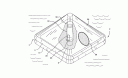 DBC Marine Safety Systems Ltd. invented an inflatable reversible life raft and applied for a patent (No. 2,233,846).  During the course of any patent application, it is common for the Patent Office to send an examiner’s letter to the applicant, requesting further information or amendments to comply with the Patent Act. In its reply to one such letter, DBC’s patent agent responded to one of the requests, but overlooked the other request.  The Patent Office and Patent Act are both clear that if a response is completely silent in respect of any of the requests in an examiner’s report, then the application will be deemed to be abandoned.Â
The initial 6-month time period lapsed, and the notice of abandonment was issued after the 12-month reinstatement period had expired. In other words, the patent agent made a mistake by overlooking the one request, and the Patent Office failed to follow their normal practice of providing a “courtesy†notice of impending abandonment. The result was that the application was treated as abandoned and could not be reinstated.  In the recent Federal Court of Appeal decision in DBC Marine Safety Systems Ltd. v. Canada (Commissioner of Patents) (Trial Decision here ), the Federal Court of Appeal dismissed the appeal and upheld the decision of the Patent Office to treat the application as having been abandoned.  Â
Calgary – 10:30 MST
Â
No commentsPrivacy Decisions: Biometric Data
 What do nursing homes and nightclubs have in common? In these 2 decisions, they both collect biometric data on their employees.
Biometric data can be anything that records “measurable characteristics” of an individual – from thumbprints to voice-prints to DNA. Organizations will collect and use this data with greater frequency as tracking technology becomes less costly and more reliable. So what do privacy laws say about this kind of information?
Two recent decisions from the Information & Privacy Commissioner of Alberta tackle biometric data collection issues head-on.
In Report of an investigation on the use of a hand recognition system, (August 7, 2008) the Commissioner investigated a nursing home in Calgary. The nursing home phased out employee swipe-cards, and introduced a hand-scanner as a way of tracking employee arrival and departure. The Commissioner decided that hand-scan data (measurements of a person’s hand to generate a unique identifier) does qualify as “personal information” under the Freedom of Information and Protection of Privacy Act (FOIPPA), and that the employer’s collection practices did not meet the requirements of that Act.
In Report of an Investigation into the Collection and Use of Personal Information, (August 27, 2008) the Commissioner looked into a complaint by an employee of an Edmonton nightclub, who was obliged to use a thumbprint sign-in system at the beginning of every shift. This time, the Commissioner made its analysis under the Personal Information Protection Act (PIPA) since the employer was a private sector organization. The employer did not collect thumb-prints but rather “unique numeric identifiers which represent distinct attributes of thumbprints” – a difference that should have been made clear to employees. This data qualified as “personal information” within the meaning of that Act, and in this case, by failing to explain its privacy policy, and thereby failing to obtain informed consent, the employer did not meet the requirements of PIPA.
The lessons for business? In both cases, the employers stumbled, but not on the type of data collected – the Commissioner accepted the employers’ argument that biometric data collection was reasonable and justified – but rather the employers both failed to adequately explain the collection process, answer questions and alleviate employee concerns. As the Commissioner stated: “Employers …have a heightened responsibility to be open and transparent about their practices as they relate to employees…”
Calgary – 10:00 MST
No commentsCanadian Do-Not-Call List In Effect
The Canadian Do-Not-Call List (DNCL)Â goes into effect tomorrow.Â
The CRTC (Canadian Radio-television & Telecommunications Commission) is coordinating the DNCL and starting September 30, Canadian consumers can register their telephone numbers on the DNCL for free. The DNCL is designed to reduce the number of telemarketing calls and faxes directed to consumers, and is to be financed from telemarketers’ subscription fees.Â
If consumers still receive telemarketing calls 31 days after registering on the DNCL, they may file a complaint, and violations may give rise to fines of up to $1,500 for individuals and $15,000 for corporations. In practice, it is often difficult for consumers to determine which organization is calling, so complaints will likely be limited to situations where the telemarketer is easily identifiable.
Of course, there are limitations. Consumers must renew their registration every three years if they want their number(s) to stay on the National DNCL. Exempt telemarketers include:
- registered charities seeking donations;
- newspapers looking for subscriptions;
- political parties and their candidates;
- companies that have an existing business relationship with a consumer (within the previous 18 months); and
- organizations directing calls and faxes to businesses.
Also, this is unlikely to prevent annoying calls from American telemarketers who will be beyond the reach of the CRTC.Â
However, it is a good step forward. Now the government needs to tackle national anti-spam legislation.
Calgary – 10:30 MST
No comments
