The Journey of a Thousand Infringements: IP In China

Maybe the journey of a thousand infringements starts with one bottle of “Future Cola”.
The ongoing battle between Groupe Danone and its Chinese joint-venture partner Wahaha is now well documented around the internet. In recent months, the dispute has spiralled into litigation, arbitration, and competing press-releases.Â
In 1996, pursuing a model that is popular with many Western companies, Groupe Danone, the French food-and-beverage giant, decided to jump-start its foray into China by partnering with a well-positioned local player. Wahaha, a successful Chinese beverage maker, already had a growing business in iced tea, fruit drinks, water and soft drinks. Its “Future Cola” brand, with red packaging reminiscent of another well-known cola product, is already making inroads into the US market.
The joint venture seemed to be a mutually profitable arrangement until allegations started surfacing this year that Wahaha was producing and selling identical products on its own, outside the scope of the joint-venture, essentially cutting Danone out of these sales and infringing the intellectual property provisions of the JV agreement. Danone does not seem to have faith in the ability of the Chinese legal system to enforce its intellectual property rights, and has opted for a lawsuit in the US and an arbitration claim in Sweden. Wahaha responded by initiating its own arbitration claim on home turf in China.
Whatever the outcome, the dispute now stands as a cautionary tale for Western companies doing business in China. Make sure you get good local counsel, have a back-up plan for enforcement and be careful who you partner with. Hot opportunities abound, but beware: even the biggest players can get their fingers burned when playing in China.Â
Â
Calgary – 10:22 MST
1 commentCanadian Patent Update
The Canadian Intellectual Property Office has announced a few changes to patent practice this summer. These are a few of the highlights:
- Changes in Title: For changes in ownership that occurred prior to the filing of an application for a patent, applicants now need only provide a declaration (rather than evidence)Â of the chain of title.
- “Small Entity” Definiton: Small entities pay lower fees for filing. The definition of “small entity” for these purposes is now defined as an entity that employs 50 or fewer employees. Entities that are controlled directly or indirectly by an entity that employs more than 50 employees are excluded, as are entities that have entered into a license with an entity that has more than 50 employees. Universities also qualify as small entities by definition.
- Electromagnetic Signals: Claims to electromagnetic and acoustic signals are forms of energy and are not patentable. This does not apply to methods, processes, machines or manufactures involved in the generation, transmission, reception, or processing of such signals.
Â
Calgary – 11:10 MST
No commentsBreakthrough in Open Source Litigation
In our earlier post about open-source software, we made reference to the SCO Litigation, a sprawling nest of lawsuits entangling SCO, IBM, Novell, Red Hat, and licensees of the Unix software system such as DaimlerChrysler.Â
The central issue was SCO’s contention that IBM had, without SCO’s authorization, contributed proprietary Unix code to the open-source Linux system. If Unix was owned by SCO and the code was contributed without SCO’s consent, then this allegation threw doubt on the legal status of Linux and in turn the entire open-source service industry that has grown up around Linux.
Last Friday, a US court ruled that the copyright in the Unix system belongs to Novell, not SCO. This deflates SCO’s central claims for relief for copyright violations and breach of contract. The litigation has taken on a life of its own, so I’d be surprised if Friday’s ruling wasn’t appealed.  But it does provide some measure of relief for proponents of open-source.
Calgary – 11:50 MST
No commentsInternet Services Contract Upheld
In the US case of Asch Webhosting, Inc. v. Adelphia Business Solutions Inv., LLC, No. 04-2593, 2007 WL 2122044 (D.N.J. July 23, 2007)  (Link to Evan Brown’s Post) the court upheld a limitation of liability clause in a dispute between an internet services provider (ISP) and its customer.Â
After the customer was accused of spamming, in violation of the ISP’s acceptable use policy, the ISP decided to terminate service, giving the customer 30 days to find a new provider. At the end of the 30 days, the ISP cut-off service as threatened, prompting the customer to sue for $1.4 million in consequential damages.Â
The court upheld a limitation of liability clause in the service contract, which capped the ISP’s liability at the amount paid by the customer for the services. The court reviewed several factors in coming to its conclusion:
- This was a business-to-business contract, with equal bargaining power between the parties;
- The customer was given ample warning of the impending cut-off;
- The clause was clear and unambiguous;
- The ISP relied on spamming complaints in good faith and there was no evidence that the ISP’s actions were malicious or in bad faith.
So you mean the fine print is there for a reason after all??Â
Â
Calgary – 11:25 MST
1 commentCanadian E-Commerce Update
Online sales in Canada grew by 40% to $49.9 billion last year. In the retail sector alone, more than 15% of retailers in Canada made online sales in 2006, up from only 10% the previous year. A pair of new Supreme Court of Canada decisions has clarified e-commerce law in Canada by upholding mandatory arbitration clauses and class-action waivers.Â
1.   Dell: For a few days in 2003, Dell’s website contained a pricing error where certain handhelds were incorrectly offered at fire-sale prices. Although Dell moved quickly to correct the errors, a number of consumers managed to place online orders at the incorrect prices.  Dell refused to honour those orders. In response, the consumers tried to institute a class action lawsuit against Dell. Dell insisted that the matter had to go to arbitration under the terms of the online contract. Enter the lawyers.
In the resulting case of  Dell Computer Corp. v. Union des consommateurs, 2007 SCC 34, the Supreme Court of Canada upheld Dell’s online contract and the case was referred back to arbitration. Although Dell’s online contract did not appear on the sales page (it was merely referred to via a hyperlink) the Court decided that this was not fatal to the enforceability of the contract.
2.    Rogers: The case of Rogers Wireless Inc. v. Muroff, 2007 SCC 35 involved a dispute about wireless roaming charges. In that case, the Court applied the same principles as in Dell and upheld a mandatory arbitration clause in the Rogers service contract.Â
As we noted in our earlier post mandatory arbitration clauses and class-action waivers are now ineffective in Ontario and Quebec under consumer protection legislation.Â
Â
Calgary – 10:45 MST
1 commentThe Chocolate Bar Caper: Copyright & Parallel Imports
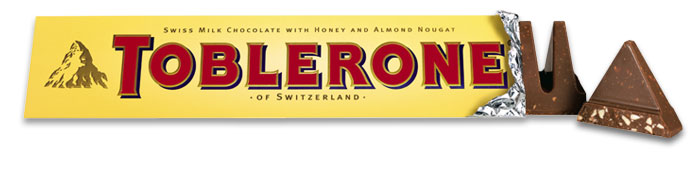 In an earlier post we discussed the use of copyright to control product distribution. In the 2005 case of Euro Excellence, Inc. v. Kraft Canada Inc., the Federal Court of Appeal upheld an injunction against an unauthorized distributor of “grey market†Toblerone chocolate bars, based on an innovative claim of copyright infringement. Under that decision, copyright seemed to provide a useful tool against parallel importers, where legitimate products are imported into a territory outside the official manufacturer’s supply chain. Trade-mark law does not provide any help in this area after the decision in Coca-Cola v. Pardhan, another Federal Court of Appeal decision. Copyright however seemed suitable to the task.
The case was appealed up to the Supreme Court of Canada and in its convoluted decision (Euro-Excellence Inc. v. Kraft Canada Inc., 2007 SCC 37), the Court now appears to have removed copyright as a tool in parallel importation cases.  The majority agreed that copyright protection should extend to product labels and agreed that if a work is entitled to copyright protection, then it should be protected like any work, without an analysis of whether the work is “incidental†or whether the copyright holder has a “legitimate economic interestâ€.  But the majority decision also made it clear that copyright is no longer a viable option for manufacturers in parallel import or “grey market” cases in Canada where the local distributor relies on an exclusive license to prevent importation.Â
Â
Calgary – 12:30 MST
No commentsAnti-Camcording Law & Olympic Marks Law
Canada gained two new intellectual property laws in June: the Olympic Marks legislation, (officially Bill C-47, the Olympic and Paralympic Marks Act) which provides a new species of “super-protection” for Olympic trade-marks, and a new anti-camcording law, which amends the Criminal Code to prohibit unauthorized recording of a movie (officially Bill C-59).
Calgary – 11:00 MSTÂ
5 commentsOnline Contract Amendment Not Binding
After Talk America bought AOL’s long distance telephony business, it amended several terms in the service contract, adding an arbitration clause, a class-action waiver and a New York choice-of-laws clause. Talk America implemented these amendments by posting them to its website.
When a customer tried to sue Talk America, lawyers attempted to deflect the lawsuit, invoking the mandatory arbitration clause and citing the class-action waiver.  However, in this case the customer had originally signed on with AOL, prior to the amendments made by Talk America.Â
In Douglas v. U.S. District Court for the Central District of California, No. 06-75424 (9th Cir. July 18, 2007) the Court of Appeals put these amendments to the test. Generally the court decided that the online postings were not binding on the customer, noting “Parties have no obligation to check the terms on a periodic basis to learn whether they have been changed by the other side.”Â
In Canada, this issue was considered by the Ontario Superior Court in its 2002 decision in Kanitz v. Rogers Cable Inc. (2002), 58 O.R. (3d) 299. In Kanitz, Rogers posted the amendments on its customer support webpage and the court decided that Rogers had provided its customers with sufficient notice of the amendments.  Mandatory arbitration provisions and class-action waivers (such as the ones at issue in Kanitz) are now ineffective in Ontario under consumer protection legislation that was introduced in July, 2005 in response to the Kanitz decision.
How does a company amend its service contracts? Very carefully.
Online postings of contract amendments are more likely to be effective when the original contract permits such changes, the customer is provided with sufficient notice of the changes, and the notice provides a clear explanation of the changes. The changes must comply with local consumer protection legislation.
Â
Calgary – 12:30 MST
1 commentUS Court of Appeals Cites Infringing YouTube Video
Law Professor Eric Goldman has picked up on an interesting twist in an otherwise commonplace trade-mark infringement case that went to the US Seventh Circuit Court of Appeals (Central Manufacturing, Inc. v. Brett, 2007 WL 1965673 (7th Cir. July 9, 2007).Â
The case involved famous baseball player George Brett and it’s clear that the judge was a serious baseball fan. On page 3 of the decision, Judge Evans recounts a scene from a 1983 Yankees game and indicates that:
“The whole colorful episode is preserved, in all its glory, on YouTube, at http://www.youtube.com/watch?v=4Cu1WXylkto (last visited June 6, 2007).”
If you link there now, you’ll find the standard warning that “This video is no longer available due to a copyright claim by MLB Advanced Media.“ It was taken down after a complaint by the copyright owner. In other words, the Court of Appeals has encouraged readers to access infringing content, something warned about in the Perfect 10 case. Applying the analysis regarding contributory infringement, did the Court know of infringing activities and fail to take “reasonable and feasible steps” to refrain from providing access to infringing content? If so, they might be liable for contributory infringement!
This case shows a couple of things:
- Judges and courts are becoming more technologically savvy (imagine a link to a YouTube video in a judgement from 5 years ago);
- Even the most well-meaning links can raise questions about infringement. Infringing links can usually be taken down if challenged, although this link is now immortalized in a Court of Appeals decision.
Â
Calgary – 11:10 MST
No commentsDisgruntled Customers Lose Domain Name
In a recent decision under the CIRA Domain Name Dispute Resolution Policy (CDRP)Â (McKee Homes Ltd. vs. Gerlinde Honsek , June 25, 2007), unsatisfied homeowners wanted to set up a customer complaint site directed at the contractor who built their home. Â The stated intent of the site was to provide a forum for customers to detail their buying experience “from a customer point of view”.Â
The domain name mckeehomes.ca was identical to the contractor’s trade mark MCKEE HOMES and the contractor launched a complaint under the CDRP. The arbitration panel found that the registrant lacked legitimate interests in the domain name despite the stipulation in the CDRP that legitimate interests can be established if the use is for criticism.Â
The panel decided that “The Registrant can achieve her objective of criticism by adopting a domain name that is not identical to Complainant’s mark, or that does not otherwise suggest some type of connection with the Complainant.” The whole point of a criticism or complaint site is that it does suggest some type of connection to the subject matter of the critique. How close can a domain name be to the trade-mark and still be able to take advantage of the “criticism” exception in the CDRP? That is left to future decisions. Â
Â
Calgary – Â 10:30 MST
No commentsDot-Asia Domain Coming Fall 2007
The dot-asia top-level domain (for example: www.yourcompany.asia) is the Asian cousin of the dot-eu domain which was launched for Europe in 2006. The new dot-asia domain will be introduced in phases, starting in October 2007.Â
According to the preliminary information provided by the registrar, anyone can be a registrant for dot-asia domains. In order to satisfy the eligibility requirements, one of the associated contacts for the applied domain must be a “legal entity in Asia” which means either a natural person or an organization such as a corporation within the Asia-Pacific region as defined by ICANN.
Trade-mark owners whose trade-marks were applied for in the designated Asia-Pacific region prior to March 16, 2004 will be eligible for advanced registration during the dot-asia sunrise period . Canadian companies with trade-marks in Asia should review their eligibility and consider submitting their applications to take advantage of the sunrise period. This kind of preventive measure can save significant costs when compared with chasing cybersquatters after the general registration opens.
Â
Calgary – 14:35 MST
1 commentAuto Maker Wins Trade-mark Fight: A Strategy Lesson
In a trade-mark battle between Hyundai and its Canadian auto-parts manufacturer, Hyundai has scored a victory (Cross-Canada Auto Body Supply (Windsor) Limited v. Hyundai Motor America 2007 FC 580 (CanLII)). Hyundai is the subsidiary of the well-known Korean auto manufacturer, and is engaged in a trade-mark infringement lawsuit with its Canadian auto-parts maker, Cross-Canada Auto Body Supply. As part of its defence strategy in the infringement lawsuit, Cross-Canada tried to exploit a vulnerability in Hyundai’s Canadian marks.  Cross-Canada used this vulnerability to launch an attack on the validity of five of Hyundai’s trade-marks.  This can be an effective strategy: If Cross-Canada could win an order that the Hyundai marks were invalid, then Hyundai’s infringement lawsuit would fail. Â
Ultimately, Hyundai beat back this challenge by tendering expert survey evidence of the public’s perception of the Hyundai marks. Survey evidence of this type is not cheap, but when a company’s core marks are at stake, this kind of expenditure is necessary. Hyundai convinced the court with this evidence and upheld the validity of all but one of its marks.
The lessons for business?
- In trade-mark litigation, an effective defence strategy will include all options, including expungement proceedings, and (of course) possible settlement; Â
- For the trade-mark owner, expert evidence can be critical to convince the court of the public’s perceptions of the mark.
- Preventive measures (in Hyundai’s case, recording the assignment of the trade-marks earlier could have reduced their vulnerability) are always cheaper than reactive measures.
Â
Â
Calgary – 12:34 MST
Â
Â
Â
Â
1 commentAustralian Sentenced to 51 Months for Copyright Infringement
Australian software hacker Hew Griffiths was sentenced last week to over 4 years in prison on one count of “conspiracy to commit criminal copyright infringement” ending his long-running battle to avoid extradition and sentencing in the US. This is on top of the nearly three years he spent incarcerated at a detention center in Australia while fighting the US extradition bid.
Seven years jail time for copyright infringement? Seems a bit over the top, but Mr. Griffiths found himself the new poster-boy for the US Department of Justice in their effort to make an example of a notorious code-cracker, and one who made the mistake of boasting that he would never be caught.
Calgary – 19:44 MST
No commentsThe Financial Side
A few weeks ago the Alberta Securities Commission released its review of the Canadian capital markets, comparing Alberta to the markets in Ontario and BC. The Alberta Capital Market: A Comparative Overview 2007 Report  provides some interesting perspectives on where Alberta stands in different industries in relation to its cousins to the east and west.
While on the topic of capital markets, technology companies are always open to new sources of financing. Here are a few sites which provide some information for entrepreneurs:
- Ask the VC has good content which is generated on a question-and-answer basis. It is US-based, so the tax issues will not apply to Canadian entrepreneurs.
- Canadian Entrepreneur has a Canadian focus and some interesting articles for growing companies such as “Anatomy of a Startup”.
Calgary – 10:35 MST
No commentsSweet Victory for Splenda Competitor
 
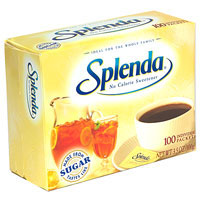
Decide for yourself: if you see these two products on the grocery store shelf, will you be confused and mistakenly buy generic “Sucralose”, thinking it’s brand-name SPLENDA?
Â
Â
McNeil Nutritionals, the makers of SPLENDA brand artificial sweetener, lost in court (McNeil Nutritionals, LLC v. Heartland Sweeteners LLC, 2007 WL 1520101 (E.D. Pa.)) in its attempt to block the sales of a competitor’s product. McNeil alleged that the competitor’s brand infringed on the SPLENDA trade dress with its distinctive yellow packaging and graphics.  Heartland makes private-label sweeteners for a number of retailers, including Giant, Stop & Shop, Food Lion, and Safeway.  The private-label packaging is also yellow, with blue font and white coffee-cup graphics.
The court disagreed with McNeil and denied the injunction application. One of the court’s findings was that health-conscious consumers who purchase sugar alternatives will take care in making buying decisions and therefore won’t be easily confused. In Canada, the factors considered by the courts are:
-
the existence of good-will in the trade dress or trademark;
-
deception of the public due to a misrepresentation, and
-
actual or potential damage to the plaintiff.
McNeil’s bid to shut-down a competitor demonstrates the importance of brand recognition in a competitive marketplace.
Â
Â
Calgary – 11:30 MST
No commentsExtradited to US for Copyright Violations
An Australian man has been extradited to the US to face sentencing for copyright infringement. Hew Griffiths, a ringleader in an undergound software piracy network, was a resident of Australia who never set foot in the US to commit copyright infringement. Nevertheless, the US doggedly pursued extradition against Griffiths. Earlier this year he admitted to his role in an international ring engaged in the illegal reproduction and distribution of more than $50 million worth of pirated software, movies, games and music. Griffiths is not alleged to have personally profited from the copyright infringement.Â
This case is one of the first ever extraditions for an intellectual property offense and represents a growing aggressiveness on the part of software publishers to defend against international piracy. Sentencing is scheduled for later in June, 2007 and Griffiths faces a possible 10-year jail term.
Â
Calgary  – 12:45 MST
Â
1 commenteBay User Agreement Upheld
In previous posts we have reviewed the enforceability of click-through agreements. The US Tenth Circuit Court of Appeals has recently upheld eBay’s user agreement. In Nazaruk v. eBay, Inc., 2007 WL 1417287 (10th Cir. May 15, 2007), a lawsuit was brought in Utah, arising out of eBay’s feedback forum.  eBay sought to dismiss the lawsuit, asserting that eBay’s user agreement mandated California as the proper venue. eBay won at the trial level. The court agreed with eBay that “eBay’s User Agreement, the operative document governing the relationship between Ms. Nazaruk and eBay, contained a forum-selection clause (Santa Clara County, California) that was both enforceable and mandatory.”
The appeal court upheld the enforceability of the user agreement and dismissed the suit.Â
Â
Calgary – 10:23 MST
No commentsPirates of the Theatre: Proposed Anti-Camcording Law
The Federal Government is planning to introduce an anti-camcording law which would target bootleggers who record first-run movies in the theatre. This appears to be a proposed amendment to the Criminal Code and perhaps also the Copyright Act, although details have not yet been released.
CTV News speculates that “If the bill passes next fall, cheap and readily available copies of popular current releases will presumably be less frequent in Canada and on the worldwide market. “ This claim is extremely doubtful but the government is facing pressure to at least appear to be combatting piracy and this proposed legislation eases that pressure.
Â
Calgary – 12:25 MST
1 commentRolling out the Settlement Agreement: General Mills vs. Kraft Foods
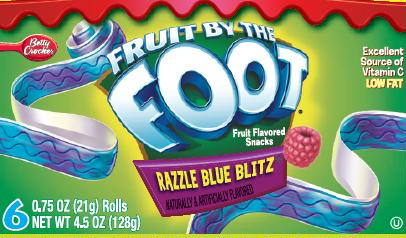 General Mills sells a rolled fruit snack under the trademark FRUIT BY THE FOOT, and has obtained not one but two patents: U.S. Patent Nos. 5,284,667 (“Rolled Food Item Fabricating Methods”) and 5,723,163 (“Rolled Food Item”). How mashed fruit and corn syrup can be a patentable invention is a separate issue.Â
General Mills sued Farley, a rival maker of rolled fruit snacks, for patent infringement. The parties settled out of court, and the resulting agreement made it clear that Farley’s successors would benefit from the settlement terms if Farley sold its entire “rolled food product business”. Farley later sold its assets to Kraft Foods, and Kraft Foods in turn sold part of the Farley assets to a third company. General Mills then sued Kraft for patent infringement.
Did Kraft’s sale of part of the Farley assets strip Kraft of the protection in the settlement agreement, and expose it to a patent infringement suit by General Mills? The Federal Circuit Court of Appeals said no, in General Mills v. Kraft Foods (Fed. Cir. 2007) stating that there was nothing in the agreement to deprive Kraft of protection as Farley’s successor. General Mill’s “covenant not to sue” applied to Kraft as successor.
The lessons for business?
- When buying intellectual assets, ensure your lawyers review any past litigation and any Settlement Agreements to assess the scope of protection for successors;
- General Mills wanted to control the onward sale of assets through the settlement agreement – this is possible, but the terms must be clear in the settlement agreement and this case provides some guidelines on how that should be done;
- And yes, even rolled fruit can be an intellectual asset.
Â
Calgary – 09:54 MST
Â
No commentsOnline Advertising Rules
 Microsoft’s acquisition last week of aQuantive for $6 billion in cash shows the lengths that technology companies will go to muscle into the online advertising market. Microsoft paid a substantial premium at $66.50 per share, compared with aQuantive’s closing price on Thursday of $35.87 per share. The deal follows on the heels of Google’s $3.1 billion acquisition of DoubleClick Inc. in April. A pair of recent US decisions considered the law relating to search engines and online advertising:
In Site Pro-1, Inc. v. Better Metal, LLC (E.D.N.Y. May 9, 2007), the court decided that keyword triggering and metatag usage in online advertising does not qualify as trademark use and therefore cannot constitute infringement. For the court, the question was whether the trademark was placed visibly on any goods, displays, containers, or advertisements – if the trademark was not displayed to consumers, no infringement could take place. This analysis differs from decisions elsewhere in the US, so the debate continues.Â
In Perfect 10, Inc. v. Amazon.com, Inc. (9th Cir. May 16, 2007), the Court of Appeal decided that Google’s display of thumbnail images in search results should be considered “fair use” and therefore did not constitute copyright infringement. While this decision is generally considered good for search engines, the court also left open the question of contributory infringement, and when search engines can take advantage of the defences available under the DMCA .
Â
Calgary – 11:45 MST
1 comment
