MySpace Nabs UK Domain
The domain name < myspace.co.uk > was registered in August 1997, fully six years before MySpace, the now-famous social-networking site, was even founded in 2003. In a recent decision (MySpace, Inc. vs. Total Web Solutions Ltd.) under the dot-uk domain name rules, MySpace has won a dispute that appears to break new ground. MySpace was able to convince the decision-maker that it should be entitled to take over the dot-uk domain name, even though the registration occurred before MySpace existed.
Until now, many analysts have agreed that the relevant time to measure whether a domain name was registered in bad faith is the date of registration, not the date of the complaint. This decision seems to have stepped around that detail, and found that the registration was “abusive” because of what happened since 2005, after MySpace had started establishing an international reputation.Â
Maybe the UK registrant should have taken the $430,000 offer that MySpace reportedly put on the table in the negotiations leading up to the complaint. With the stakes that high, it’s no wonder the losing party has filed an appeal of this decision.Â
While this decision is not binding on decision-makers in dot-com or dot-ca dispute procedures, the appeal will be watched closely to see how the consensus is developing on this issue.
Calgary – 10:45 MST
2 commentsCanadian Trade-mark Battles
If we were to rank intellectual property battles over Canadian culture, last month’s dispute in PEI over the use of the trade-marks surrounding Anne of Green Gables might beat out last year’s domain name fight over Hockey Night in Canada . Third place might go to last year’s trade-mark spat between Tim Horton’s and an American professional bass fisherman by the same name in Muscle Shoals, Alabama. In a rare moment of Canadian cultural imperialism, the coffee-and-donut icon forced Mr. Horton the fisherman to abandon his US trade-mark application for 1 TIM HORTON.
Calgary – 22:32 MST
No commentsLook Out Apple, Here Comes Meizu


There was a time when the words “Made in Japan” were synonymous with cheap, low quality trinkets. Today those words are the hallmark of high-quality electronics. The words “Made in China” are on the same path. From an intellectual property and trade-mark perspective, there are cheap knock-offs – like Mickey-Mouse t-shirts and pirated DVDs. And then there are legitimate, cutting-edge imitators that just might beat the original product in its own backyard.
Case in point: the Meizu M8 or miniOne (the one on the right, if you were wondering) is in the vanguard of made-in-China products that will soon be competing directly against Western technologies like the Apple iPhone (on the left). Not only in the US, Canada and Europe, but perhaps more importantly, in the ballooning consumer markets in China and India.
The miniOne is no slouch in the technology department and it appears to be backed up by its own IP portfolio – Meizu’s patent application in China was laid bare earlier this month (See images from the patent application from the State Intellectual Property Office of the PRC or SIPO). In this arena the game for IP owners is no longer one of trying to squelch cheap knock-offs, but to compete head-to-head, armed with IP protection for patents, trade-marks and copyright, at home and overseas. And to watch out for the miniOne in a store near you.
Related reading: China’s iClone
Calgary – 11:30 MST
Fast-Track Canadian Patents
The Canadian Intellectual Property Office has announced its participation in the Canada-U.S. Patent Prosecution Highway (PPH) pilot project. This experimental program, which has been in the works for some time, is designed to help fast-track patent examination in both Canada and the U.S. and increase efficiency in the patent examination process. The PPH project is also being used by other intellectual property offices, including the Japan Patent Office, the United Kingdom Intellectual Property Office, and the Korean Intellectual Property Office. During the initial one-year pilot period, CIPO won’t require a fee to process requests for accelerated examination under the PPH project.
Â
Calgary – 10:45 MST
No commentsBusiness + Technology: Resources
Some of the common issues facing Canadian businesses today are: ensuring compliance with e-commerce laws, handling employee surveillance issues and protecting brands online. The following links relate to online contracting and e-commerce in Alberta, as well as employee surveillance issues and online brand strategies for Canadian business:
- E-Commerce: Alberta Internet Sales Contract Regulation
- E-Commerce & Privacy: Alberta Investigation Report P2007-IR-007 – A case in which Ticketmaster contravened PIPA by requiring on-line customers to consent to the use of personal information for event provider’s marketing purposes as a condition of ticket sales transactions.
- Video Surveillance (Federal Case): Eastmond v Canadian Pacific Railway, 2004 FC 852 – in this case, the Federal Court reviewed video surveillance under federal privacy laws and articulated a four-part test.
- Video Surveillance (Provincial Case): Talisman Centre For Sport and Wellness Order P2006-008 (Alberta) – in this case, the Alberta Privacy Commissioner reviewed video surveillance under provincial privacy laws and confirms a three-part test for reviewing the appropriateness of video surveillance.
- Video Surveillance (Provincial Case): R.J. Hoffman Holdings Ltd. Investigation Report P2005-IR-004 (Alberta) – in this case, the Alberta Privacy Commissioner reviewed video surveillance in an employment context, under provincial privacy laws.
- Domain Name Decision: Neteller PLC vs Prostoprom – in this recent decision, Neteller successfully challenged the registration of a domain name under the UDRP rules, and the panel reviewed a number of common issues that were all present in this case: confusing similarity, likelihood of confusion, commercial use when using affiliate advertising programs or pay-per-click advertising, and the use of disclaimers.
- Community Trade Mark (EU): Regulations
Calgary – 20:00 MST
No commentsTrade-mark Injunction Update
Our earlier post reviewed one of the decisions in the ongoing trade-mark dispute between Cross-Canada Auto Body and Hyundai, the Korean car manufacturer. This is a dispute over the distribution of Hyundai auto parts.  Hyundai’s injunction application recently failed on appeal (Hyundai Motor America v. Cross Canada Auto Body Supply (Windsor) Limited.), under the three-part test set out by the Supreme Court of Canada:
- There must be a serious question to be tried in the main action.
- It must be demonstrated that in the absence of an interlocutory injunction the plaintiff will suffer irreparable harm; and
- It must be demonstrated that the balance of convenience as between the parties favours the grant of an injunction against the defendants.
The Federal Court of Appeal reinforced the prevailing law that injunctions can be difficult to obtain in trade-mark cases and this factor must be taken into account in any trade-mark litigation strategy.Â
Calgary – 10:45 MST
No commentsiPhone Patent Infringement Suit
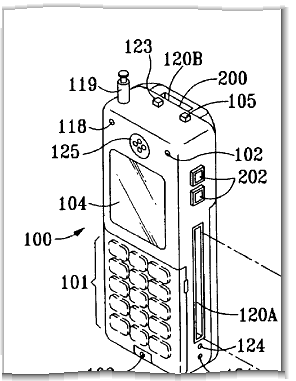 It was only a matter of time before someone took a run at Apple’s famous iPhone and it is reported that Minerva Industries, Inc. launched a patent infringement lawsuit against Apple on Tuesday, mere hours after the unknown company was told that its US patent issued (Patent No. 7,321,783 entitled “Mobile Entertainment and Communication Device”). A portion of figure 1 from the patent is excerpted at left.
From reading the claims, this inventor should have every cell-phone maker on the planet running scared. Something tells me the cell-phone industry will try and compare notes on this one to dig up some prior art. Apple is no stranger to IP lawsuits over its iPhone. After all, the product was launched in the midst of a highly-publicized trade-mark infringement fight.
Calgary – 21:35 MST
No commentsVirtual Rights Protection
There are virtual lawyers, virtual commerce, virtual brands. So logically someone has finally opened what purports to be the Second Life Patent and Trademark Office saying: “We allow you to register, protect, and add value to your Second Life creations to protect your intellectual property rights.”Â
It is unclear how virtual protection of virtual rights would function in Second Life (let alone First Life). There have been more real-world disputes over virtual rights, including a real lawsuit  launched a few months ago by virtual business operators Le Cadre Network and others who complain of copyright infringement and passing off within Second Life.  Bear with me here…  The complainants in that suit filed (real) copyright registrations for their (virtual) products in the (real) US Copyright Office. Maybe they can convince their lawyers to charge virtual legal fees.Â
Â
Calgary – 11:45 MST
No commentsE-Commerce Update
In what might be a high-water mark for online vendors, a decision of the US Third Circuit Court of Appeals in Schwartz v. Comcast Corporation has upheld the terms of a subscription agreement even in the absence of any proof that the customer actually knew of, let alone assented to the terms. This echoes the reasoning of the Supreme Court of Canada in the Dell case last year. In Dell the online contract was referred to in a linked document, but did not appear on the sales page. It was at least arguable that a customer would be aware that a contract existed even if the customer never took the time to read those terms.Â
In the Comcast case the court went one step further stating that: “in some cases, a party is excused from the terms of a contract where he never had access to the contract and thus could not make himself aware of its terms. However, in this case, the terms of the contract were available to Schwartz via the web site, and thus they are binding, despite the fact that he was unaware of them.” The customer argued that he never received any notice of any terms and was therefore completely unaware that there were terms for him to find.Â
Does this mean that merely posting the fine-print on the company website will suffice to make online terms binding? Probably not. Comcast was able to convince the court of its practice of providing the Subscriber Agreement to all new customers. Consistent corporate practices are critical to establishing evidence that the terms should be upheld. Canadian courts may not go this far, but it does provide some guidance for Canadian companies doing business online with US customers.
Â
Calgary – 17:00 MSTÂ
Â
Â
No commentsUS Patent Reform
An interesting article in the NY Times gives an update on the US patent reform process and the battle lines that are drawn between large technology companies such as Intel, Microsoft, IBM and Apple, who are looking for ways to take away leverage from small-time patent holders, and the pharmaceutical industry which traditionally relies on robust patent protection.’
And if you want some more light reading, try the draft report prepared by the Senate Judiciary Committee on the Patent Reform Act of 2007.
Â
Calgary – 15:25 MST
1 commentIntellectual Property Control
There is growing debate (and some misinformation) about the control by private interests over the very essence of language and thought in our society. For example, some of the analysis over the Olympic and Paralympic Marks Act (which came into force in December, 2007) has suggested that anyone uttering the number “2010” in the same breath as “gold medal” will be subject to sanction at the hands of VANOC, the defenders of the Olympic brand. VANOC has tried to explain its approach to infringement assessment to manage this issue. They seem to be applying an even-handed analysis to enforcement, although I’m sure someone will find a way to test the bounds of that law.
Similarly, the current interest in copyright reform in Canada is fuelled by a perception that giving private companies increased protection over copyright will result in a privatization of language and culture itself.Â
A recent article in the Toronto Star is a case in point.  The article makes some good arguments but Canada’s intellectual property laws do not prevent someone from using the phrase “freedom of expression” just because someone has registered that slogan as a trade-mark. Infringement involves an analysis of the use of a mark in association with certain goods or services which are the subject of the trade-mark registration.Â
The law should engage in a balancing act between competing interests.  Let’s hope that the current groundswell of public interest in intellectual property law will help lawmakers reach that balance.
Â
Calgary – 10:10 MST
1 commentThe Politics of Domain Names
Alberta Premier Ed Stelmach is in good company: he joins Julia Roberts, Kevin Spacey and Mick Jagger, not to mention lesser celebrities such as one-time federal MPs Don Boudria and David McGuinty. This club can boast of the price that comes with celebrity in an internet age, since they’ve all had their personal names registered by someone else as domain names. In 2000, Julia Roberts fought and won a domain name dispute case over juliaroberts.com, paving the way for other celebrities and politicians to win back their domain names, including Mick Jagger and Kevin Spacey. In those cases, the panelists did not have trouble finding that celebrities have rights to their own names, even though the dispute resolution policy does not specifically say as much.
The dispute resolution procedure for dot-ca domain names (CDRP) is not identical to the UDRP which applies to dot-com domain name disputes. And further, a personal name has not yet been the subject of a dot-ca dispute under the CDRP. This means any attempt to run this dispute through the CDRP will break new ground.
Calgary – 23:30 MST
IP and Internet Law in 2008
Four intellectual property topics to watch in the new year:
Canadian Copyright Changes
The government’s announcement of new copyright legislation has generated considerable debate in Canada in the last few weeks – when copyright reform hits the front page of the Globe and Mail, then you know something is up.  So far all of the media interest, including a Facebook group of several tens of thousands of concerned citizens, seems to have triggered a review of the proposed legislation. We will be watching to see what the bill looks like.
Filesharing
We are hoping to see some clarity in this area in 2008. The recording industry seems to be pushing for an opportunity to litigate, and the proposed copyright legislation may address this issue, providing guidance to content-providers, musicians, users and industry alike.
US Patent Reform
The proposed patent reform bill in the US is currently making its way through Capitol Hill and the changes effected by the new law will undoubtedly transform the patent landscape. We’ll keep an eye on these developments south of the border because of their impact on so many Canadian patent holders and inventors.
Privacy Online
Privacy issues will continue to play a central role in the conduct of online business. Massive privacy breaches have become almost common-place – announcements of lost data or hacked credit card info now seem to be weekly occurences - and Canadian law in this area is changing as new decisions and investigations try and produce guidelines for business. Watch for this area to continue to evolve over the next year.
Â
Calgary – 10:35 MST
No commentsOpen Source Resources
There seems to be a run on BusyBox litigation this fall and the lawyers at the Software Freedom Law Center (SFLC) have been busy; last week they filed another copyright infringement lawsuit against Verizon Communications, Inc., alleging violation of the GNU General Public License (GPL). The open source movement is expanding past the world of software into areas of biological and life sciences. Because of the growing interest in this area, we have decided to compile a list of resources regarding open source organizations and law.
Software
Software Freedom Law Center: http://www.softwarefreedom.org/
Free Software Foundation: http://www.fsf.org/
Open Source Initiative: http://www.opensource.org/Â
Biotech / Life Sciences
The BiOS Initiative:http://www.bios.net/
BiOS Compatible Agreement Listing:
http://www.bios.net/daisy/bios/licenses/2997.html
Public Intellectual Property Resource for Agriculture: http://www.pipra.org/
Tropical Disease Initiative: http://www.tropicaldisease.org/
WCLP: http://www.westcoastlicensing.com/index.htmÂ
AFMnet: http://www.afmnet.ca/Â
LES Presentation Slides: lespresentation-open-source.pdf
Calgary – 16:00 MST
Â
2 commentsFilesharing Update: A Torrent of Lawsuits
In our earlier post we reviewed a recent US lawsuit against (the now-famous) Jammie Thomas involving filesharing and copyright infringement allegations south of the border. That fight is continuing and lawyers at the Electronic Frontier Foundation have decided to assist on the appeal.  Â
In Canada, the filesharing site Demonoid closed its doors last month after cease-and-desist letters from the Canadian Recording Industry Association. Their site now contains the simple greeting: “The CRIA threatened the company renting the servers to us, and because of this it is not possible to keep the site online.” CRIA succeeded in shutting the site down, but filesharing sites are like prairie dogs – the moment one pops down a hole, another is emerging somewhere else.Â
It appears that the real fight is brewing in Quebec over the filesharing site QuebecTorrent. Last month, 31 members of the recording industry (including Sony BMG Music Canada, Universal Music Canada and EMI Group Canada) launched a lawsuit against the site, seeking a preliminary injunction to shut it down. QuebecTorrent managed to defeat that application and keep its doors open for the time being. This case may represent the first opportunity in Canada to test — or make — the law in this area, so both sides are preparing for the fight.  At the moment, filesharing is not specifically legal in Canada although no court has had an opportunity to review the specifics of a filesharing case.
This is one to watch.
Â
Calgary – 11:22 MST
1 commentOnline Defamation Decision
There have been a string of cases in Canada dealing with defamation in the internet context, providing useful guidance in this area. It seems that old fashioned defamation in hard-copy newspapers will remain a quaint memory from the last century. The last case we covered was from British Columbia – the latest decision comes out of Ontario.
In Warman v. Fromm and Canadian Association for Free Expression Inc., (Ontario Superior Court of Justice – Case No. 04-CV-26550SR), the court reviewed a string of defamatory postings and rejected the defence of fair comment. The court awarded general and aggravated damages totaling $30,000, and ordered the defendants to post full retractions within 10 days.
Calgary – 10:35 MST
No commentsTrade-mark Dilution Update: Louis Vuitton v. Haute Diggity
It’s a classic clash of Euro-couture and irreverent American parody. This time, the Americans won.
The famous French hand-bag company sued the US maker of “Chewy Vuiton” dog toys. The decision a year ago in Louis Vuitton Malletier S.A. v. Haute Diggity Dog, LLC was appealed and the TTAB (Trademark Trial and Appeal Board) recently issued its decision upholding the lower court’s ruling. The appeal court agreed that Haute Diggity Dog’s products are not likely to cause confusion with those of Louis Vuitton and that Louis Vuitton’s copyright was not infringed. The “Chewy Vuiton” dog toys were considered “successful parodies” of Louis Vuitton’s trademarks, designs, and products. (Louis Vuitton Malletier S.A. v. Haute Diggity Dog, LLC, US Fourth Circuit Court of Appeals, No. 06-2267 (Decided: November 13, 2007))
Â
Calgary – 10:30 MST
1 commentInfringement of Patent on Higher Life Form
The decision earlier this year in Monsanto Canada Inc. v. Wouters 2007 FC 625 (Barnes, J.) marks the first damage award in a case pitting Monsanto against a farmer in Canada. In the 2004 landmark case of Monsanto Canada Inc. v. Schmeiser, 2004 SCC 34, [2004] 1 S.C.R. 902, Monsanto sued a Saskatchewan farmer for unauthorized use of Monsanto’s patented Roundup Ready Canola, a canola variety containing genetically modified genes and cells. The court decided that Schmeiser had infringed Monsanto’s patent by growing the plants on his farm, but Schmeiser “did not gain any agricultural advantage from the herbicide resistant nature of the canola since no finding was made that they sprayed with Roundup herbicide to reduce weeds.” In short, the farmer earned no profit from the patented invention and Monsanto was not entitled to any compensation for the infringement.
In the Wouters case, the Ontario farmer may have been able to raise the Schmeiser defence (or any number of other defences). Problem is, Wouters never filed a proper defence, leaving the court with little choice but to declare Monsanto the winner by default. The court concluded that Wouters infringed the patent by growing, harvesting and selling 392 acres of soybeans which Wouters knew contained the patented genes and cells. The resulting damage award of over $100,000 appears to mark the first award for infringement of a patent covering a so-called “higher life form” in Canada.
Yes, the Supreme Court of Canada in the famous Harvard Mouse Case decided clearly that “higher life forms” are not patentable in Canada. However, the same court in Schmeiser had to admit that the individual cells are patentable, and the patented genes and cells are not merely a part of the plant; rather, the patented cells compose its entire physical structure. So the court may not want to permit the patenting of higher life forms, but the higher life forms are inseparable from the patented cells of which they are comprised. You can’t destroy all the cells and leave the plant alive.
Life forms have a way of getting up and moving around: seeds propagate and blow away, creatures crawl, viruses replicate and invade. Where will the Monsanto cases go when they grow legs and start crawling around the patent landscape?Â
Â
Calgary – 09:35 MST
First GPL Suit Settles; Second Round Begins
The lawsuit Andersen and Landley v. Monsoon Multimedia Inc, (No. 07-CV-8205) which promised to tackle the enforceability of the GPL head-on has settled, with Monsoon agreeing to appoint an Open Source Compliance Officer to monitor its use of open source software. Flush with this success, the lawyers at the Software Freedom Law Center promptly filed two new lawsuits, this time against Xterasys Corporation and High-Gain Antennas, LLC, also for violation of the terms of GPL in connection with the use of BusyBox open source code.
Calgary – 20:35 MST
1 commentCanadian Copyright Changes Coming
According to the Ottawa Citizen, the government’s new copyright reform bill may be tabled within a matter of weeks. Hopefully there is more input into the next set of changes to the Copyright Act than there were to the recent anti-camcording law which came into effect several months ago. Last week, police made their first arrest  under the new law – a man who was trying to record “Dan in Real Life” in a Montreal area theatre.
Calgary – 20:35 MST
No comments
