IP & Internet Law in 2007 (Part 2)
Internet Trends
User-generated content (not only from blogs and YouTube, but also from Reuters and the BBC) is on the rise.Â
As users continue to mash-up their own content with content borrowed from elsewhere, the intellectual property fur will continue to fly. Expect copyright battles, trade-mark skirmishes and technological protection measures to make headlines as ordinary citizens test the boundaries of “user-rights” vs. copyright.
Trade-marksÂ
There are not too many areas of the economy where branding and corporate identity are not a critical issue. The Supreme Court of Canada weighed in on two significant trade-mark cases in 2006: the court reviewed “famous marks” in the Barbie case (Mattel Inc. v. 3894207 Canada Inc), and in the case of Veuve Clicquot Ponsardin v. Boutiques Cliquot Ltee. Trade-marks will continue to overlap with internet law and inter-jurisdictional issues, as we have seen in cross-border disputes such as the Pro-Swing vs. Elta case.
Domain NamesÂ
Trade-mark owners can’t rest as domain name battles become a full-time occupation. Some developments are helpful: WIPO issued its Overview of Panel Views which serves as a useful guide for those engaged in UDRP disputes. Other developments are less encouraging: consider how the click-through ad-revenue system favours cybersquatters who can turn a quick profit from domain names which capitalize on the reputation of brand owners. Microsoft’s battle with these cybersquatters will be interesting to watch as the law continues to play catch-up with technology.
Â
Thanks to all of our readers in 2006. We will continue posting in 2007.
Calgary -Â 09:25 MST
No commentsIP & Internet Law in 2007 (Part 1)
Lawyers are known for looking back, but we prefer to look ahead. Here are some themes and developments in the rapidly evolving world of intellectual property and internet law.Â
CopyrightÂ
The courts were busy in 2006 in the copyright arena. We can expect a few more important decisions (such as the appeal of the Toblerone copyright case) to go to the Supreme Court of Canada in early 2007. One important theme in copyright is the attempt to use copyright to protect areas which aren’t the traditional domain of copyright: in the Toblerone case, the copyright holder succeeded. In the case of Plews v. Pausch 2006 ABQB 607, an Alberta graduate student attempted to use copyright to protect mere ideas and theories, and lost.
Privacy
Privacy is not within the realm of intellectual property but it almost always overlaps with technology issues. Besides the regular reports of missing laptops and hacked data, consider two cases: One, the infamous Sony Rootkit case, in which Sony CDs embedded hidden software on the hard-drives of customers as part of the company’s copyright protection strategy. The strategy landed Sony in a hornet’s nest of privacy issues. Class action settlements were finalized in 2006.Â
Second, consider the Alberta case of Doctor Dave Computer Remedies. In that case, the Alberta Information and Privacy Commissioner found that Doctor Dave Computer Remedies used and disclosed the Complainants’ personal information (including names, email addresses, mailing addresses and phone numbers) contrary to the Alberta Personal Information Protection Act by posting that information on websites.Â
Privacy issues will continue to be front and centre in 2007 as Parliament continues its review of PIPEDA, while other technologies, such as RFID tags, continue to raise privacy concerns.
IP Litigation
In 2006, the courts helped clarify enforcement issues for IP litigators.  In decisions such as Celanese Canada Inc. v. Murray Demolition Corp., an industrial espionage case, the courts helped clarify the boundaries for the use of Anton Piller orders in civil cases where evidence is being seized. The cases of Pro Swing Inc. v. Elta Golf Inc. and Disney Enterprises Inc. v. Click Enterprises Inc, dealt with the enforcement of foreign judgements in Canada.
Calgary – 13:17 MST
No commentsRIM Protects BlackBerry Turf
As our market-driven society evolves, branding will present an ever-growing challenge. How do you distinguish yourself from a field of competitors and navigate through the minefield of existing trade-marks? Â
Samsung tried to do that in early December when it launched its new BlackJack, a “smart” phone with email capability and QWERTY keyboard.  Competitors noticed. In particular, one little Canadian company that makes a “smart” phone with email capability and QWERTY keyboard that you may have heard of: BlackBerry. Last week, RIM sued Samsung for trade-mark infringement. BlackJack and BlackBerry. Confusingly similar? A California court will decide. The lesson for business? You better have a high degree of confidence in your trade-mark before you spend millions launching that next product.
Â
1 commentDomain Name Games
In August 2006, Microsoft launched a series of lawsuits in the U.S. against alleged cybersquatters. This in itself is not necessarily newsworthy, considering the number of battles Microsoft and other famous trade-mark owners have to fight on an ongoing basis to protect their trade-marks online. In this case however, the sheer volume of registrations was noteworthy. The cybersquatters had registered hundreds of domain names which were variations and common misspellings of Microsoft’s trade-marks, such as microsoftnewssource.com, msninfoonline.com, freewindowslive.com and msnblog.com.Â
This brand of cybersquatting might be called “next generation” since it doesn’t rely on the traditional method for profiteering. Instead of making money by selling the infringing domain name back to the rightful owner, or to a competitor, the domains have value because of their ability to generate per-click ad revenue. The infrining domains are parked at a generic page which lists ads, all of which will generate revenue when misdirected visitors click through in the search for the legitimate site or page they were looking for.  Multiply this by hundreds of domain names and bingo, you’ve got yourself a profitable side-line, all based on ad-revenue.Â
The ad-driven frenzy is reflected in “domain kiting“. Domain kiting or domain tasting is the practice of registering a domain name speculatively and testing the ability of that domain name to generate traffic (and ad revenue) during an initial registration period. Most registrars offer a refund if a domain registration is cancelled during this initial period. Cybersquatters are using this period to register thousands of domain names, test drive them, and return them if the profitability potential doesn’t justify the registration cost.Â
Microsoft, like other trade-mark owners, is using all legal means available in the battle against online trade-mark infringement, including UDRP complaints, and lawsuits based on trade-mark infringement and the US Anti-Cybersquatting Consumer Protection Act . In Canada, there is no corresponding statute, so trade-mark owners must decide between the Trade-marks Act and the CDRP . Microsoft lost one battle under the CDRP involving a .CA domain name. The domain name msnsearch.ca was registered by Canadian company Microscience Corp. Microsoft alleged the domain name was confusingly similar to its MSN family of trade-marks. Microscience fought back. In the decision the panel agreed that there was confusing similarity, Microsoft lost on the grounds that there was no “bad faith” on the part of Microscience since it was not a competitor of Microsoft and the registration did not prevent Microsoft from registering its own trade-marks as a domain name.
The lessons?  Cybersquatters move fast and trade-mark owners have to educate themselves on the legal tools available to play hardball in these domain name games. The tools include arbitration under the applicable dispute resolution policy, and litigation using trade-mark laws in the country having jursidiction over the infringer.Â
Calgary – 13:02 MST
No commentsIntellectual Property Rights in the Grinch®
In the holiday spirit, we can’t resist analyzing the intellectual property rights in the Grinch. How did a grouchy green cave-dweller become a multimillion dollar IP asset?Â
Copyright
The original book “How the Grinch Stole Christmas” was written in 1957 by Theodor S. Geisel under the pseudonym Dr. Seuss. The copyright in the character and the related trade-marks is owned by Dr. Seuss Enterprises L.P., a California limited partnership created after the author’s death to handle licensing of the Dr. Seuss empire. The copyright in the original book is owned by the publisher, Random House Inc.Â
An animated television special was created in 1966 by Metro-Goldwyn-Mayer, Inc., now part of the Time Warner empire; the copyright in the television production is now owned by Turner Entertainment Co. The copyright in the music in the television production (based on the book) was originally owned by Metro-Goldwyn-Mayer, Inc. as employer for hire of Theodor S. Geisel and Albert Hague. RCA Records published a compilation of songs from the television production.Â
In 2000, the movie rights were acquired by Universal and the copyright in the movie “Dr. Seuss’ How the Grinch Stole Christmas!”, directed by Ron Howard, is owned by Luni Productions, a Universal production company. A novelization of the movie (based on the original book) was written by Louise Gikow and copyright is owned by Universal Studios Licensing Inc.
Inevitably, someone decided that the story was fit for a musical production: “Dr. Seuss’ How the Grinch Stole Christmas! The Musical” opened in San Diego in 1998 and moved this year to Broadway. The copyright in the musical (lyrics and music) is owned by Timothy Mason and Mel Marvin.
All under license of course.
Trade-marksÂ
The word GRINCH is a registered trade-mark of Dr. Seuss Enterprises L.P. in Canada.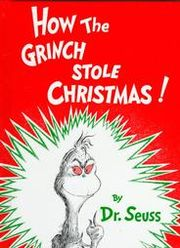  In the US, the GRINCH trademark was registered by Dr. Seuss Enterprises LP in 2000 for T-shirts, shirts, tops, sweaters, hats, headwear, aprons, sweatshirts and any other merchandising category you could think of. Interestingly, an individual by the name of John Christopher Chlebowski, Jr. obtained the first trademark registration for the word GRINCH, claiming a date of first use in 1991 for “entertainment, namely, live performances by a musical band.”
Domain Names
The domain name grinched.com  is owned by Universal Studios for use with its movie-related website, under license from Dr. Seuss Enterprises.  The domain name howthegrinchstolechristmas.com is registered by an unknown registrant and currently resolves to a “domain for sale” site (which would make a good case for “bad faith” registration under the Uniform Dispute Resolution Policy arbitration procedure).
Patents
The Grinch is mentioned in several U.S. patent applications, although no-one has yet found a way to make the character himself the subject of a patent. For example, United States Patent No. 6,982,780 (filed by inventors Steven Morley, et al.) which issued on January 3, 2006, claims patent rights in a method for creating a playlist for a digital cinema system. The work “How the Grinch Stole Christmas” is mentioned in the claims description as an example of the use of the invention.
Licensing
Dr. Seuss Enterprises L.P. with Audrey Geisel at the helm, appears to control all trade-mark and copyright licensing of the original Grinch character and related paraphernalia as well as the entire Dr. Seuss line of products, and has licensing deals for countless spin-off products. The movie licensing is handled by Universal Studios Licensing, Inc., which is itself originally under license from Dr. Seuss Enterprises L.P.   Although Dr. Seuss died in 1991, he has consistently made the Forbes list of top-earning deceased celebrities due to the marketing engine of Dr. Seuss Enterprises L.P. It generated $10 million last year. For the movie version of the Grinch, the licensing company took 4 percent of the box-office gross, 50 percent of the merchandising revenue and music-related material, and 70 percent of the income from book tie-ins. We haven’t even touched on the licensing for Universal’s theme-park.
Infringement
Alas, we have uncovered no Grinch lawsuits, although few literary characters would be more suitable as a plaintiff. It seems to us that Mr. Chlebowski, armed with a trademark registration for the word GRINCH in association with “entertainment, namely, live performances by a musical band” would have a claim against the producers of the live musical version of the Grinch story, but we have seen no effort on the part of Mr. Chlebowski to pursue that action. Perhaps the prospect of shutting down a family Broadway musical during the Christmas season is a bit too unpalatable, even for a GRINCH trademark owner.
Calgary -Â 23:11 MST
1 commentEnforcing Foreign Judgements in Canada
The Canadian trade-mark RIDENT for golf clubs is confusingly similar to the US trade-mark TRIDENT for golf clubs. That’s the easy part. Now, how do you confine a Canadian company from selling its RIDENT brand golf clubs over the internet to US consumers who may be familiar with the rival TRIDENT brand? We’ve got e-commerce, intellectual property rights and court orders. Just the thing to take to the Supreme Court of Canada.
In Pro Swing Inc. v. Elta Golf Inc. 2006 SCC 52, the Supreme Court of Canada (SCC) tackled this problem on a number of levels. Pro Swing, owner of the TRIDENT trade-mark in the US, initially obtained an order from a US court, stipulating that the Canadian company, Elta Golf, should cease sales of RIDENT brand golf clubs into the US. But in practical terms, the court order was only enforceable in the US and Elta Golf was an Ontario-based company. Pro Swing commenced a lawsuit in Canada to enforce its US judgement.Â
Traditionally, foreign judgements can be enforced in Canada where they are a final order to pay a defined sum of money. Or put another way, where compliance is relatively easy to enforce and monitor: either the money has been paid, or it hasn’t. In the Pro Swing case, the US order was a “foreign non-monetary judgment”. In other words, it carried with it a number of non-monetary orders and stipulations. The SCC has now clarified that these types of orders can be enforced in Canada. Unfortunately, the court was split on when they should be enforced. Here are some of the factors the Canadian court will take into consideration:
â—Â Â Â Â Â Â Â are the terms of the foreign order clear enough?
â—Â Â Â Â Â Â Â is the foreign order sufficiently limited in scope?
â—Â Â Â Â Â Â Â is it a final order?
â—       is enforcement of the order a justifiable use of Canadian judicial resources?Â
In the end Pro Swing’s US judgement was not enforced by the court. The lessons for business? First, foreign litigants seeking to enforce their foreign judgements in Canada now have a greater range of options available to them; they are not confined to monetary orders alone.  Secondly, because of the thicket of issues which a Canadian court will consider, it is wise for US counsel to seek advice from Canadian counsel prior to drawing up the terms of the US order to ensure it stands the greatest chance of enforcement in Canada.  Third, in practical terms, the world of e-commerce just got a little cozier: cross-border business and internet sales mean that Canadian and US companies will continue to come into conflict and this decision effectively shrinks the gap between foreign and Canadian courts.
Calgary -Â 09:59 MST
1 commentUniversal’s Zune Deal: A Case Study in Creative Revenue Sharing
Early in November, Universal Music Group announced an innovative deal with Microsoft. As part of the negotiations leading up to the launch of Zune (Microsoft’s competitor to the iPod), Universal cut a deal to get a royalty payment for every Zune player sold by Microsoft. This is separate from the royalties generated by the sale of downloaded music from Universal’s catalogue.Â
How did Universal negotiate this and why did Microsoft agree to share its (probably slim) margins on the device? Let’s call it an alignment of interests. Microsoft needs the big music catalogues on side if its Zune is going to put a dent in Apple’s mighty iPod. Secondly, the Zune is marketed by Microsoft as a “social” vehicle: the wireless capability of the Zune player allows users to share their music with other Zune owners.  In legal terms, this means that content subject to copyright can be distributed to unnamed users who have not directly acquired any rights to the music.  Sound like a recipe for a copyright lawsuit? Not if you cut a deal that aligns interests. If Universal enjoys a cut of sales of the device, then it has a vested interest in having as many Zune owners as possible. To answer any fears that one Zune owner can distribute music infinitely, the technical protection measures kick in. The device can only share with other Zune devices within range, and the shared music actually times out after three days. Music sharing?  It’s more like a short-term loan.Â
For its part, Universal had two other motivators: one, the Diamond Rio case in the U.S. made it clear that MP3 players were not subject to the type of copyright levy applied to blank CDs and other digital recording media. In Canada, the Federal Court of Appeal came to the same decision in 2004. So iPods and Zunes are not generating tariffs for copyright owners the way blank CDs are.   Second, Universal also has its eye on upcoming negotiations for the renewal of its contract with Apple. With the Microsoft deal in its back pocket, Universal will very likely look to Apple for a cut of iPod sales. Unfortunately for Universal, it does not have the upper hand in that round of negotiations. Apple’s iTunes accounts for the lion’s share of the legal download market and any threat by Universal of pulling its catalogue from iTunes would be akin to shooting the goose that’s laying the golden eggs.Â
Instead of positioning themselves for a future battle over copyright, Universal and Microsoft used a little creative thinking to align business interests.  It will be interesting and instructive for business owners to watch as the deal-making unfolds. Â
Calgary -Â 08:38 MST
No commentsThe Innovative Use of Copyright
The use of copyright as a tool to control distribution channels and protect product lines is not new. Neither is it confined to the traditional fields of music or software. Take for example the 2005 case of Euro Excellence, Inc. v. Kraft Canada Inc., 2005 FCA 427, where the Federal Court of Appeal upheld an injunction against an unauthorized distributor of “gray market” Toblerone chocolate bars, based on a claim of copyright infringement. Gray marketing refers to the distribution of genuine goods by a distributor who is outside the manufacturer’s official supply channel.
Manufacturers of all stripes seem to be employing copyright as a way to control unauthorized uses of their product. Take for example Viacom’s well-drafted copyright license terms on the back of its “Dora the Explorer” branded stickers: “This product is intended solely for non-commercial home use. No license has been granted to apply this product to decorate articles which will thereafter be sold. Any such use is an infringement of copyright in the characters portrayed and is specifically prohibited.” Viacom’s Dora figure is big business. In 2005, Viacom’s revenues in Canada alone were $214 million, generated in part from licensing and merchandising of branded products such as Dora stickers. Copyright can be a very useful tool which should be considered when developing a strategy for product distribution.
Just don’t let your pre-schoolers put any Dora stickers on the cups at their sidewalk lemonade stand.
Calgary – 16:04 MST
No commentsDirector’s Liability for Trade-mark Infringement
Can a director be personally liable for trade-mark infringement?  We raised this issue in our October 25th post. A recent Federal Court decision has re-examined this question. Generally, directors and shareholders are considered to be legally separate from their corporation and are not personally on the hook for the debts or liabilities of that corporation. If the corporation breaches its contractual obligations, defaults on a loan or infringes someone else’s intellectual property rights, then it is the corporation, not the individual, who is liable.
In the case of Petrillo v. Allmax Nutrition Inc., 2006 FC 1199 (CanLII), the plaintiff brought an allegation of trade-mark infringement against both the corporation and Richard Glover and Michael Kichuk, the directors of that corporation. The individual defendants brought a motion to have the lawsuit dismissed against them personally. They succeeded. In coming to its decision, the court made several important points:
One, even though a small company may be controlled by one or two individuals who may function as shareholders, directors and officers, the authorization required for personal liability will not be inferred merely from the fact that a company is closely controlled. Secondly, the court said that “it is not enough for a Plaintiff to assert personal liability on the part of an officer or director of a company in a statement of claim, in the hope that evidence to support the allegation will be uncovered during the discovery process. A lawsuit is not a fishing expedition.” (at para. 36)
In the end, no evidence was brought forward to implicate the directors personally and so the lawsuit against them was dismissed.Â
Calgary -Â 14:02 MST
No commentsCopyright Takes Aim at Video Sharing
In the ongoing copyright wars, some of the most memorable battles were fought by Sony BMG and Universal against upstarts like Napster and Grokster.  Napster and Grokster were ahead of their time. Alas, like many pioneers, they were effectively litigated out of existence. Today, dozens of industry-sanctioned sites like iTunes and Puretracks are flourishing.Â
With the upsurge in video file-sharing sites, are we going to see a new round of battles, this time over copyright in video and movie content? The answer to this question will lie in the degree to which the industry becomes successfully enmeshed in the success of video-sharing. Yes, we are already seeing copyright lawsuits against YouTube and MySpace. However, the difference is that these popular video-sharing sites aren’t operated by rogue individualists. They are part of well-established corporate empires: Google bought YouTube; MySpace is owned by News Corp., the parent company of Fox Interactive. YouTube has already negotiated deals with CBS, Universal, Sony BMG, Warner Music and NBC. The content industry is enmeshed. If industry can generate profit through these distribution models, the battles will be between competing empires over who has the most successful distribution model and the most effective copyright protection measures.Â
For Canadian video content producers, the questions remain the same as always: can content be distributed profitably or will profits leak out through copyright infringement? If copyright infringement is occurring, can it be stopped and at what cost? We’ll continue watching the latest YouTube and MySpace lawsuits to find some of the answers.
Calgary – 12:16 MST
No commentsTrade-mark Infringement Online
The world of trade-marks is regulated by several underlying concepts. One such concept is that two similar or even identical marks can coexist as long as they are in different channels of trade.  This permits the trade-mark DELTA to be used by an airline, a water faucet manufacturer and a hotel chain without any confusion. Â
In the recent decision in Louis Vuitton Malletier S.A. v. Haute Diggity Dog, LLC, 2006 WL 3182468 (E.D. Va. 2006), this concept was put to the test in the internet context.  Are online sales a “channel of trade” for the purpose of determining whether two similar marks can coexist? The famous hand-bag company sued a manufacturer of pet accessories (such as dog beds and chew toys) for trade-mark infringement. Louis Vuitton alleged that the use of the mark CHEWY VUITON infringed its LOUIS VUITTON mark. Essentially, the court disagreed. The fact that the sales of both the plaintiff’s and defendant’s products were made online was not, by itself, determinative of the issue. The court looked at a number of other factors to determine whether the two marks were used in the same channel of trade. Â
Trade-mark owners should police their marks and take steps to prevent infringers from trading on their reputation. This U.S. case provides some guidance for Canadian businesses who are trading into the U.S. particularly in the ever-expanding internet and e-commerce context. Â
Â
Â
1 commentCopyright Q & A
Many companies want some basic guidance on copyright. This discussion provides some practical tips and information on copyright in Canada.
Q. What is copyright?
Copyright is at its most basic level the “right to make copies”. It was originally developed to give writers and artists a measure of control over who can rightfully copy their works. Copyright protects original creations such as books, music, images, photographs, and has evolved to provide protection for software, layout and design of websites, broadcasts and performances. Copyright is a function of the law set out in the Copyright Act and in the court decisions which interpret that Act.
Q. How is copyright created?
Someone who creates an original work automatically enjoys copyright protection in that work by virtue of the Copyright Act. For copyright to subsist, the work must be original and it must be reduced to a fixed form (for example, copyright does not protect mere ideas which are not expressed in writing).Â
Q. Do I need to register copyright and if so, how do I do that?
Technically, you do not need to register copyright in order to enjoy the protections under the Copyright Act. However, you can benefit from registration because a registration entitles the copyright owner to the benefit of certain presumptions. In other words, you are presumed to be the owner of a work in which you have a copyright registration without having to prove that you were the author of the work. Whereas, without a registration, you would have to prove authorship and ownership of that work in the event of any dispute. Copyright registration is easy to do (relative to patents or trade-marks, for example). The Canadian Intellectual Property Office provides more detailed guidance on that process.
Q. What can I do if someone else uses my copyrighted works without my permission?Â
When someone else uses works in which you enjoy copyright protection and they don’t have your permission, this is what we call copyright infringement. There are a number of exceptions in the Copyright Act which permit copying under certain circumstances, but if those exceptions are inapplicable, then you may be able to sue the infringer to prevent the unauthorized copying. The Copyright Act permits copyright holders to collect statutory damages of up to $20,000 in certain cases where infringement can be shown.
No commentsISPs on the Front Line
Internet Service Providers (ISPs) are often on the front lines of the battles taking place in internet law. In the BMG case (BMG Canada Inc v. John Doe) (which was referred to in our October 30th post), it was the ISP community which took the brunt of the recording industry’s efforts to stop online peer-to-peer file-sharing. In that decision, the court denied the request by copyright holders to force ISPs to disclose their customers’ identities where copyright infringement was alleged.  ISPs fought to for the right to protect their client’s identities (or framed in a business context, they fought for the right to avoid expensive disclosure obligations) and won.
The Modernization of Investigative Techniques Act , a proposed federal law which was first introduced in 2005 by the Liberal government, would impose stricter obligations on ISPs to permit “lawful interception of communications by law enforcement agencies and the Canadian Security Intelligence Service.” This bill died before being passed into law, but it is certainly cause for concern for ISPs who are navigating the line between privacy rights, legitimate concerns over illegal activity, the interests of copyright holders… and the dictates of profitability in a competitive marketplace.
In a recent case in Ontario [see story link] the quick response of an ISP led to the disclosure of the identity of a subscriber and a speedy arrest by investigators. That case (involving sexual assault) highlights the issue but does not provide much guidance for ISPs in the more nuanced area of alleged intellectual property infringement. We will be monitoring developments to see whether the Conservative government will introduce legislation in this thorny area.
No commentsPharma Patent Decision Released
Last week (November 3, 2006) the Supreme Court of Canada (SCC) issued a decison in the battle between AstraZeneca and Apotex on the issue of “evergreening” the protection available for pharmaceutical products. The decision cane be found at AstraZeneca Canada Inc. v. Canada (Minister of Health), 2006 SCC 49
The Patented Medicines (Notice Of Compliance) Regulations govern patented pharmaceutical products in Canada and provide brand-name drug companies with some extra tools in their competition against generic drug manufacturers. Here’s how it works in a nutshell:  a generic drug manufacturer cannot enter the market without a Notice of Compliance (NOC) and no NOC will be issued if the proposed product is the subject of a competitor’s patent. However, a generic can challenge that patent’s validity or applicability to its own product by issuing a notice of allegation. The brand name drug company (which owns the patent) may respond by issuing its own application for a prohibition of the NOC. This response results in an automatic 24‑month “statutory freeze” on the issuance of the NOC to the generic drug manufacturer. Even after a patent expires, by applying for new improvement patents of “marginal significance” to the expired patent, the brand-name drug company can obtain an indefinite series of 24‑month statutory freezes, which can effectively shut the generic out of the market for that product. There has been much criticism of this tactic.  This decision helps clarify the rules and warns against the use of the “evergreening” tactic by patent holders.Â
No commentsOpen Source Indemnity
In October 2006, open source software company OpenLogic announced that it is offering an indemnity against lawsuits for customers using its code [story link].  The indemnity covers intellectual property infringement claims (including defense of claims, replacement of infringing software, and up to four times the value of the contract for damage awards) for claims arising out of the use of certain open-source software products. These products are listed in its Certified Library. Of course, there are limitations to the coverage, one of which is that the indemnity does not cover code which is modified by the customer.
The business issue? For licensors, offering such an indemnity is a calculated risk. In this case, it’s designed to give customers confidence in the face of the questions swirling around the open-source community in the wake of the SCO Litigation. Software licensors, whether in the open-source or traditional software market, need to balance the costs associated with risk allocation. The risk allocation analysis has to take into account the potential threat posed by software patents.  Different companies will take different approaches depending on their overall strategy. For example, Red Hat has developed its own strategy on such litigation, and has taken out a number of software patents for defensive purposes.Â
We will be watching these developments closely as open source software legal issues continue to be front-and-centre for many software companies.Â
1 commentFaster, Higher, Stronger… It’s super-trade-mark!
The Vancouver Organizing Committee for the 2010 Olympic and Paralympic Winter Games (VANOC) owns the trade-marks related to the 2010 Olympic games – what they call the “Olympic Brand”. VANOC has given notice of over a hundred marks already, all under Section 9 of the Trade-marks Act which is a unique category of trade-mark known as “official marks”.  Owners of official marks already have the benefit of some very special rights and remedies that the rest of us mere mortals can only dream of.Â
According to their recent report, VANOC is now in discussions with the federal government regarding “special legislation to protect the Olympic Brand.” In their view, such legislation would be designed “to protect [VANOC’s] marks and to prevent or reduce ambush marketing of its sponsors during the period leading up to the Beijing 2008 Olympic Games through to the end of the 2010 Games.” As if the strength of Section 9 marks is not enough they appear to be gunning for some new category of super-trade-mark. Wouldn’t it be nice if every business could lobby the government for special legislation to protect its own collection of marks? Â
Thanks to Neil Melliship for his post on this.Â
1 commentDid You Say Jail Time for Copyright Infringement?
That’s right. Jail time. Grant Stanley is the latest casualty in the file-sharing wars. The 23-year old network administrator for peer-to-peer file sharing site Elite Torrents has been handed a 5 month prison term [story link] for copyright infringement for the part he played in operating the online file-sharing system. Elite Torrents used the BitTorrent file-sharing application and was shut down in May 2006 by US federal investigators [link].
In Canada, the law on P2P file sharing activity has been in legal limbo since the court in the BMG case [BMG Canada Inc v. John Doe] indicated that downloading music files does not infringe copyright under the private copying exemption. As the court said: “Under [the Copyright] Act, subsection 80(1), the downloading of a song for a person’s private use does not constitute infringement.” So don’t expect anyone to be spending time in a Canadian jail for copyright infringement. Not any time soon, anyway. Mr. Stanley will have to wait for a Canadian pen pal on this issue.
It is the BMG decision which is referred to in the US government’s Special 301 Report which monitors countries whose intellectual property protection regime does not live up to the standards of the United States. The report, which identifies trading partners who “do not provide an adequate level of IPR [intellectual property rights] protection or enforcement”, refers in a disappointed tone to the “Canadian court decision finding that making files available for copying on a peer to peer file sharing service cannot give rise to liability for infringement under existing Canadian copyright law…”
We can expect changes to the Canadian copyright regime when Parliament gets around to it. This issue will very likely be front and centre, but probably not until 2007.
2 commentsGoogle’s Adwords Click-Through Agreement Upheld
Online contracts can provide fertile ground for disputes. The trick is to set-up your online click-through agreement in such a way that the court will have no choice but to uphold it. In October 2006, in the decision in Person v. Google Inc. 2006 WL 2884444 (S.D.N.Y. Oct. 11, 2006) [See Law Professor Eric Goldman’s link], the internet behemoth successfully deflected a lawsuit brought in New York State. Google won based on the forum selection clause in its mandatory click-through AdWords contract, which forces disputes to be brought in California, Google’s home turf. Google won the same battle in a different lawsuit in 2004 (American Blind & Wallpaper Factory Inc. v. Google, Inc., 1:04 cv 00642 LLS (S.D.N.Y. 2004)). This doesn’t mean the dispute is over. Merely that it must go forward in California.
In Canada, we’ve got the benefit of a number of cases, such as Rudder v. Microsoft, a 1999 decision which upheld the validity of Microsoft’s online MSN agreement. In a number of provinces we also have the benefit of the Electronic Transactions Act [Alberta Version] which sets out a number of requirements for e-commerce businesses.
Â
1 commentPersonal Liability of Director for IP Infringement
If a company is sued for infringement of intellectual property rights, can the director be held personally responsible? One of the benefits of incorporating a company is that the company’s shareholders and directors are not personally liable for the debts and liabilities of the company. That’s a basic proposition of corporate law. Of course, there are exceptions. In the 2006 decision in Krav Maga Enterprises, LLC v. Edge Combat Fitness Inc., the Federal Court allowed the addition of a director in a lawsuit for trade-mark infringement. Essentially, if the director or officer is engaged in “deliberate, willful and knowing pursuit of a course of conduct that is likely to constitute infringement or reflects an indifference to the risk of it” then the director can be tagged with personal liability. This is not a new idea. The Federal Court of Appeal has established this type of liability in cases such as Mentmore Manufacturing Co. Ltd. v. National Merchandise Manufacturing Co. (1978), 40 C.P.R. (2d) 164 in a case of patent infringement and another decision of the Federal Court adding a personal defendant in Dimplex North America Ltd. v. Globaltec Distributors Ltd. from 2005, a case also alleging patent infringement.Â
1 commentHow Not To Treat Your Software Developer: Civiclife.com v. Industry Canada
The 2006 decision by the Ontario Court of Appeal in the case of CivicLife.com Inc. v. Canada is instructive in how not to treat your software developer. The case involved a botched pilot project known as Access.ca which was touted as a ground-breaking portal for communities across Canada, designed to make all information and services of federal ministries and agencies accessible on-line. This was in 2000, back when we all used the endearing term “Information Superhighway.” The project foundered for a number of reasons and ended in litigation between Industry Canada and one of its contractors, a software company known as CivicLife.com Inc. It makes for a good case study, so here are a few of the lessons:
Lesson 1: Keep Track of the Cooks in the Kitchen
Sometimes you need to bring a number of technology providers together to get a project done. That’s business. However, make sure you know how many you really do need, and ensure there is a clear structure in place to deal with communication and governance. In the CivicLife case, the government engaged two contractors to work on the project: CivicLife and another software company called Smartsources.com Technologies Inc. Smartsources was the junior partner, hired to provide some of the minor components of the portal. The parties did turn their minds to the issue of communication and cooperation: in the legal agreements the two contractors were obliged to cooperate and communicate with each other and the government had established a communication structure between itself and each contractor.
But at some point in the process, someone at Industry Canada decided that Smartsources should take the lead and develop its own portal. Problem is, no-one ever told CivicLife, who continued to toil away at the project wondering why their partners weren’t cooperating. If you decide that one contractor needs to be dropped, do it early and negotiate a resolution of the issue or a termination of that contractor. Secretly encouraging one contractor while stonewalling the other will only breed confusion, inefficiency and ultimately litigation. The court found that: “The misconduct was carried out in secret while all along Industry Canada was telling CivicLife the project was proceeding as agreed, and when CivicLife learned of the portal submitted by SmartSources, Industry Canada invented a false story to convince CivicLife that its position was not altered.”
Lesson 2: The Duty of “Good Faith”
The court was clear that Industry Canada breached its duty of good faith when dealing with CivicLife. What does that mean? Essentially, the government secretly encouraged Smartsources while stringing along CivicLife with no intention of making the relationship work. According to the court, they “acted in such a way as to undermine the very objectives of the contract.” The government’s lawyers (hey, they were doing their job) argued that it was not a specific term of the contracts that the government act in good faith. Okay, they were technically correct, there was nothing expressly imposing such an obligation in the text of the government’s contracts. But that didn’t stop the court from “reading in” or implying a duty of good faith in its dealings with CivicLife. You may have a duty to act in good faith even if there is no such obligation written in your contract.
Lesson 3: The Fine Print
Of course the fine print can always come back to haunt you. And there’s nothing like litigation to shine a light on it. Here are a few nuggets from this case:
• If you have a duty to use “best efforts†you must exercise your discretion reasonably and fairly.
• If you can do something in a contract in your “sole discretion” don’t think that means you can ride roughshod over the other party. When exercising your discretion, these words can mean acting reasonably, honestly and in good faith and with regard to how the other party’s interests are affected.
• An “entire agreement” clause will not stop the court from implying a term of the contract, such as a duty of good faith or the duty not to abuse a discretion.
Lesson 4: The Value of Good Evidence
Industry Canada never provided any evidence to explain whether it ever rejected or found fault with any of CivicLife’s deliverables. It could never explain why it decided to ask SmartSources to provide a stand-alone portal or why it did not proceed with the national launch of Access.ca. If they had the evidence, it would have come out. On the other side, CivicLife could show that it sent written correspondence to Industry Canada, and this documentation helped win the case. In the court’s words: “Even though Industry Canada knew CivicLife was in dire financial straits and needed to be told the truth as soon as possible, it deliberately chose not to respond to CivicLife’s many letters and kept silent to allow CivicLife to drown in useless and expensive attempts to keep the project alive.”
This case isn’t a cutting-edge Supreme Court of Canada judgement, but it neatly illustrates some of the practical business issues to watch for. You may as well take a few tips: CivicLife ended up in receivership.
No comments
